
Why Editing Falls Behind
Sometimes it’s not your editing speed, it’s the process around it. Here are the four things that slow photographers down most, and a simple 5-step reset plan.
Sometimes it is not your editing speed. It is the process around it.
You finish a shoot, the files come in, and the edit sits there for days. You tell yourself you need to work faster. Better presets, a quicker laptop, more coffee.
But most of the time, speed is not the problem. The delay is built into the way the project moves. Here are the four things we see slow photographers and studios down the most.

1. Unclear selects
Editing starts the moment you open the folder. If you are still deciding which images make the cut while you edit, every photo costs you twice: once to choose it, once to finish it.
The signs: you reopen the same frames, you edit a shot and then drop it, you ask yourself “is this one a keeper?” halfway through a retouch.
The fix: finish selects as a separate step, before any editing. Pick the final set, mark it, and stop. Editing then becomes a clear list of work, not a decision-making session.

2. Scattered feedback
A note in an email. A comment on a call. Two lines in a DM. A voice message from the client at 11 pm.
When feedback lives in four places, someone has to collect it, and that someone is usually the editor. Things get missed, and a missed note means another round.
The fix: one place for all feedback, one person who owns it, one combined list sent back to the editor. If it is not on the list, it is not part of the revision.

3. No editing time blocked out
Editing gets squeezed between shoots, client calls, admin and posting on social media. It becomes the thing you do “when there is a gap.” The gap rarely comes.
Plus, editing needs focus. Twenty minutes here and there is slow, because you spend half of it getting back into the flow.
The fix: put editing in the calendar like a client meeting. Protect two or three real blocks each week. If the work is more than your calendar can hold, that is not a discipline problem. It is a capacity problem, and it is worth solving directly.

4. Too many revision rounds
One round of changes is normal. Four rounds means something upstream was unclear. Usually it comes down to one of two things: the style was never clearly agreed on, or the feedback came in pieces instead of all at once. Every extra round also pulls the editor away from the next project, so the delay spreads.
The fix: agree on the look before the first edit starts. Send one reference, a few sample images or a short style note. Then limit feedback to one consolidated round, with a second only for small final tweaks.
A simple reset plan
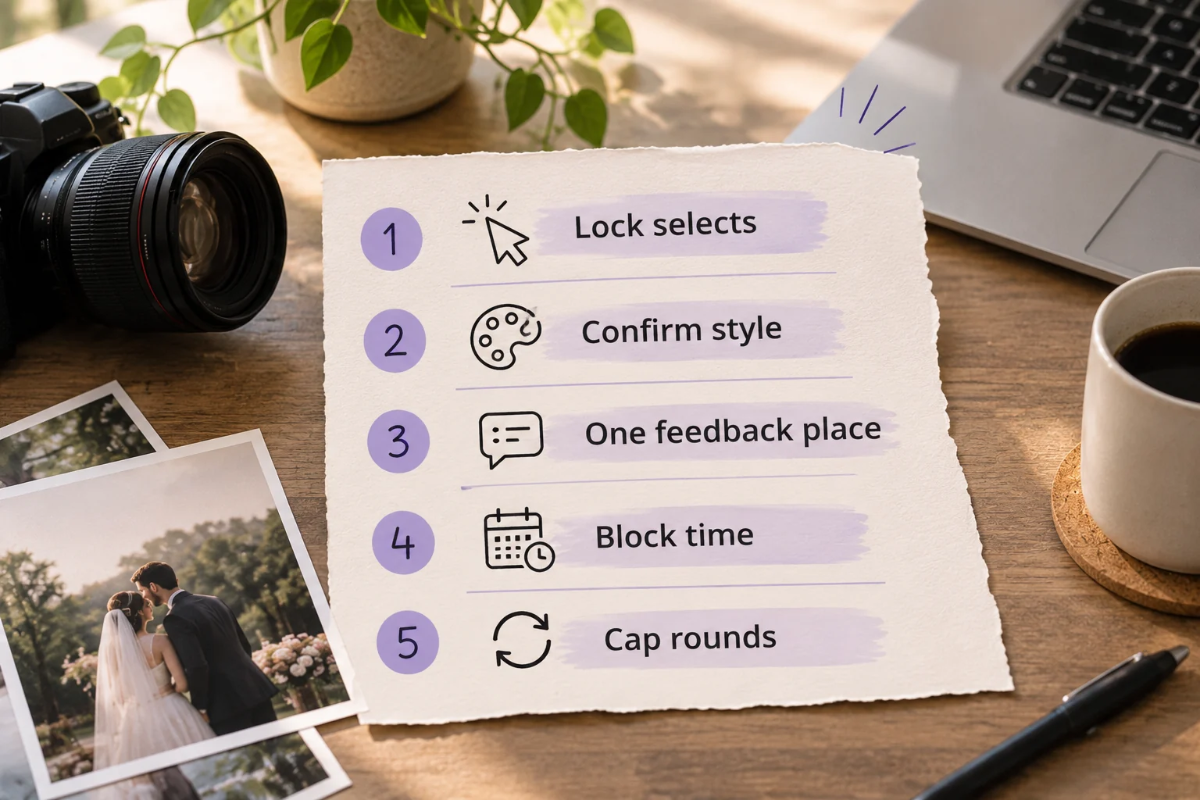
You do not need to rebuild your workflow. Try this for your next project:
Lock the selects first. Finalize the image set before editing begins.
Confirm the style up front. One reference, one short note, agreed before the first edit.
Collect feedback in one place. One combined list, sent once.
Block editing time. Two or three focused sessions this week, in the calendar.
Cap the rounds. One main revision, one light final pass.
That is it. Five small changes, and most backlogs start to shrink within a project or two.
When the backlog is a capacity problem
Sometimes you fix the process and the queue is still too long. That usually means there are simply more images than hours. This is where outsourcing helps: your selects and style notes go to a team that edits to your look, and you get your time back for shooting, clients and growth.
At Pinnacle Edits, we work with photographers and studios who want consistent, clean edits without the late nights.
Want to see how it works on your own images? Send us a few and try a free edit, no commitment.
If this was useful, follow The Post-Production Insider for more practical post-production tips.
Frequently Asked Questions
Why is my editing always behind even when I work fast?
Usually because of the process, not the pace. Unclear selects, scattered feedback and too many revision rounds add days that no amount of speed can recover.
What should I do first to catch up?
Lock your selects. Finalizing the image set before any editing starts removes the most common source of rework.
How many revision rounds are normal?
One main round and one light final pass. If clients regularly need more, the style or the feedback process was unclear before the edit began.
How do I stop clients from sending feedback in pieces?
Give them one place to send it and tell them upfront that you will do one combined round. Collect everything into a single list before it goes to the editor.
How much time should I block for editing?
Enough for focused sessions, not scraps between tasks. Two or three protected blocks a week is a good starting point, then adjust to your volume.
When does outsourcing make sense?
When your process is solid and the queue is still too long. That means the volume is more than your hours, and handing off the editing frees you to shoot and run the business.
Will outsourced edits match my style?
They can, if you share clear references or sample images up front. A short style note and a few examples are usually enough to get started.
Continua a leggere
Articoli correlati
Servizi correlati